 how-to
Does Silicone Roof Coating Stop Ponding Water?
Last Updated: November 1, 2026
Quick Summary
No, silicone roof coating does not stop ponding water. It tolerates standing water without absorbing it, but it does not drain the roof or change the slope, so the water stays where it is. Ponding is a sign that drainage needs correcting, and coating alone rarely fixes a roof that holds water by design.
- Silicone is designed to stay sealed and flexible under standing water, but it does not move water toward drains.
- Fix slope, clogged drains, or high-set drains before coating a roof that ponds.
- Coating over active leaks or trapped moisture can seal the problem inside the roof system.
- Check whether the warranty excludes ponding areas or requires a minimum slope before relying on it.
Table of Contents
- Why Ponding Water Forms on Flat and Low-Slope Roofs
- Does Silicone Roof Coating Stop Ponding Water or Just Tolerate It?
- How to Fix Ponding Water on a Flat Roof
- Silicone Roof Coating Pros and Cons
- Silicone Versus Acrylic and Urethane Coatings for Ponding Areas
- How Long Does Silicone Roof Coating Last?
- Next Steps: Inspecting Your Roof Before You Coat It
- Frequently Asked Questions
Why Ponding Water Forms on Flat and Low-Slope Roofs
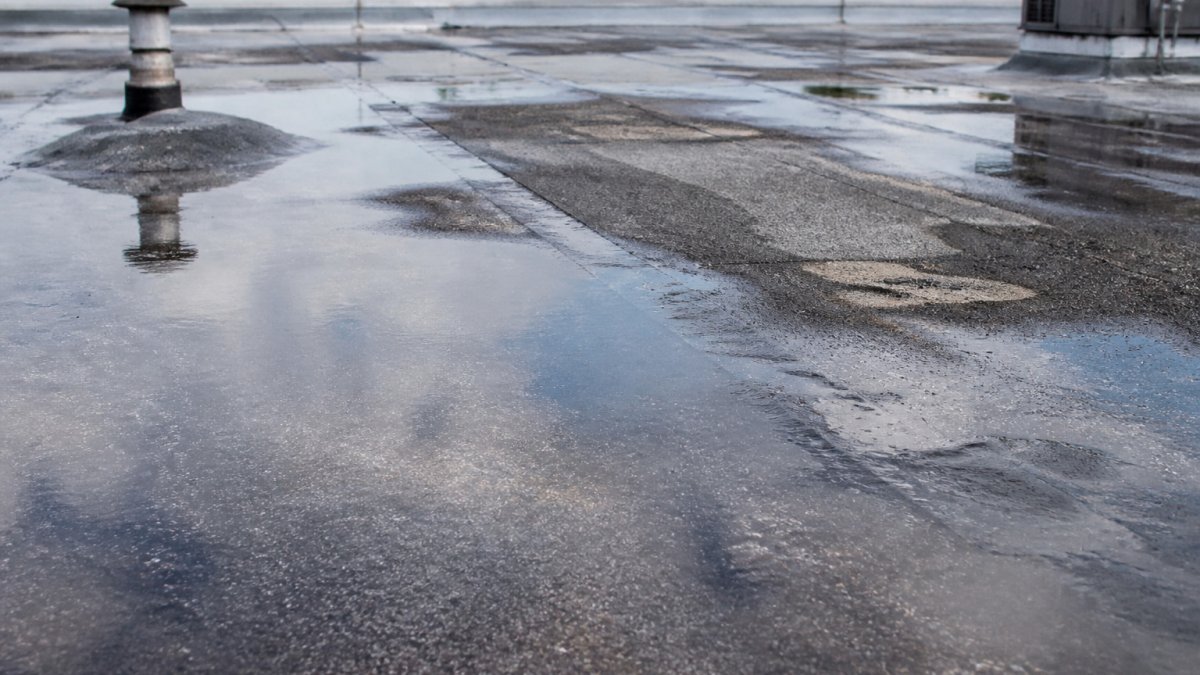
Ponding water on flat roofs is one of the most common problems property owners face.
Ponding is more than a cosmetic issue. The National Roofing Contractors Association guidance on flat roof drainage describes standing water as a warning sign that the roof needs attention, not just a surface nuisance.
Low-slope roofs are the most vulnerable. Even a small dip in the deck can trap several inches of water across a large area. Property owners often notice it only after a stain appears on a ceiling below.
Does Silicone Roof Coating Stop Ponding Water or Just Tolerate It?
Silicone roof coatings tolerate ponding water. They do not stop it. This distinction matters, and many contractors blur it when they sell coatings.
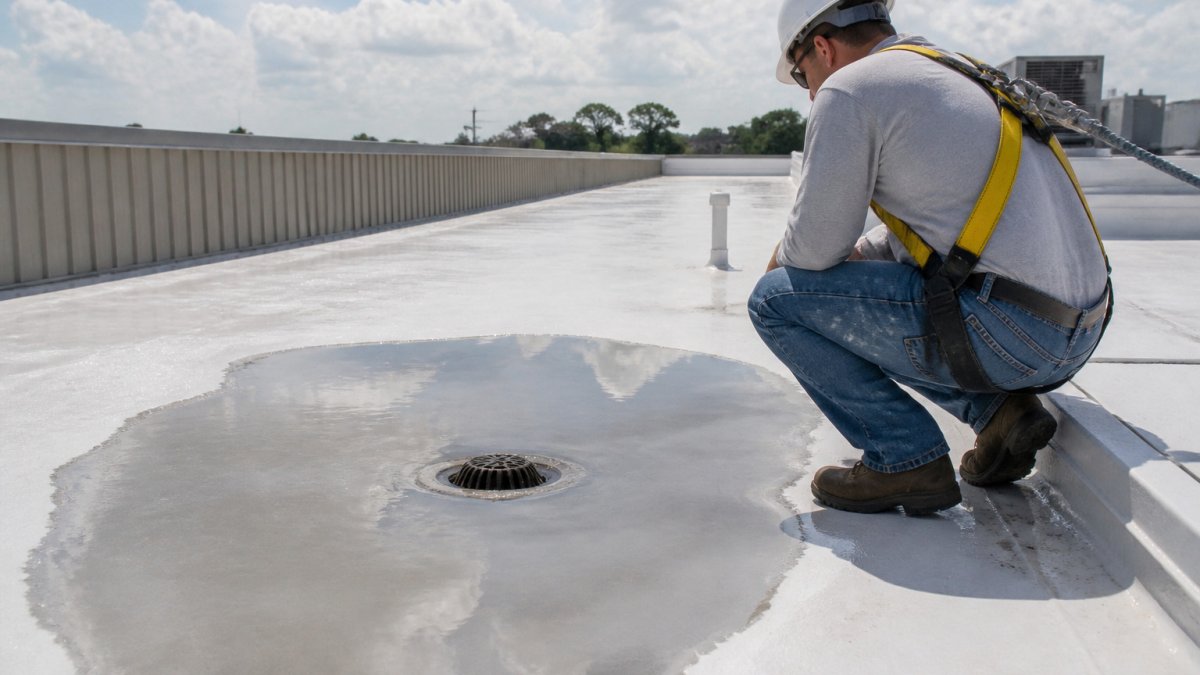
A silicone coating is designed to stay sealed and flexible while standing water sits on top of it.
Silicone can sit in ponding water but may still stress-crack and allow leaks, so resistance to ponding is not a guarantee of a leak-free roof.
Our recommendation: use silicone where the coating is the right tool, and fix drainage where drainage is the real problem. Coating alone rarely cures a roof that holds water by design.
How to Fix Ponding Water on a Flat Roof
Fixing ponding starts with diagnosis, not product selection. If you have decided to fix it, you can see whether roof coating and restoration services for flat roofs are offered across Florida. A typical sequence looks like this:
- Map the water. Walk the roof after a rain and mark where water stands, how deep it is, and how long it lasts. Note whether it drains within 48 hours.
- Check the drains and scuppers. Clear debris and confirm that each drain sits at the lowest point. A drain set too high leaves a basin of water around it.
- Measure the slope. Shallow areas may need tapered insulation or a new layer of sloped insulation to direct water toward drains.
- Inspect seams, flashing, and penetrations. Water that pools near a failed seam will find the weak point.
- Decide the fix. Correct the slope or drains first. Once drainage works, a coating can extend the roof's life and protect the membrane.
Watch out: coating over a roof with active leaks or trapped moisture seals the problem inside the system, where it can cause rot and insulation damage. Check for early warning signs with a checklist of signs your roof needs attention now. Dry and inspect the substrate first.
Silicone Roof Coating Pros and Cons
Silicone earns its reputation on ponding roofs for specific reasons, and it fails for equally specific reasons. Understanding the mechanism behind each pro and con is what separates a sound specification from a sales pitch.
Strengths, and why they matter
- Standing-water tolerance. A cured silicone membrane is hydrophobic and does not readily absorb liquid water, so prolonged contact does not swell or soften the film the way water-sensitive coatings can. That is why silicone is often specified where water sits for extended periods.
- Moisture vapor permeability. Many silicone roof coatings allow moisture vapor to escape from the assembly rather than trapping it under a vapor-tight film. On a roof with residual moisture in the insulation, that breathability can reduce the risk of blistering compared with a seamless, low-permeability coating.
- UV and heat performance. Silicone resists ultraviolet degradation and holds its reflectivity well, which supports cooling-load reduction on low-slope roofs. Reflectivity is typically expressed as initial and aged solar reflectance and thermal emittance; verify the values on the product data sheet rather than relying on a generic claim.
- Seamless, monolithic film. Applied as a fluid, silicone cures into a continuous membrane with no seams to peel, which removes a common leak path on older roofs.
- Weather-window flexibility. Silicone can usually be applied across a wider range of surface temperatures and can tolerate moisture during cure better than many water-based coatings, which helps in humid climates and shoulder seasons.
Drawbacks, and how to manage them
- Recoat incompatibility. Silicone generally will not accept acrylic or urethane topcoats, and many products require a silicone-compatible primer or tie coat. Plan the full system, base coat, reinforcement, topcoat, and any future recoat, before the first gallon goes down.
- Adhesion sensitivity. Silicone bonds well to many substrates but demands clean, dry, sound surfaces. Chalk, dust, oils, and old incompatible coatings can cause adhesion failure. Most manufacturers publish substrate-specific preparation requirements; follow them literally.
- Slip hazard when wet. Cured silicone can be slick under standing water. Where maintenance traffic is expected, specify a walkway coating or granules in traffic areas.
- Cost. Silicone typically carries a higher material cost than acrylic. Compare installed cost per square foot, not just pail price, and weigh it against the service life and warranty offered.
- It does not fix structure. Silicone does not restore slope, close a clogged drain, or repair saturated insulation. Coating a roof that holds water by design simply protects a bad design.
| Factor | What Silicone Delivers | What to Verify Before You Buy |
|---|---|---|
| Ponding water | Tolerates standing water without absorbing it | Manufacturer's written ponding-water statement and warranty exclusions |
| Moisture vapor | Generally breathable | Product data sheet permeance and substrate moisture limits |
| UV and heat | Strong UV resistance, good reflectivity | Initial and aged reflectance and emittance values |
| Recoating | Limited compatibility with other chemistries | Required primer or tie coat and approved recoat products |
| Adhesion | Strong on properly prepared substrates | Substrate-specific prep and primer requirements |
| Cost | Higher material cost than acrylic | Installed cost per square foot and warranty term |
Before accepting any ponding-water claim, ask for the manufacturer's current product data sheet and warranty, confirm the substrate and primer schedule, and check whether the warranty excludes ponding areas or requires a minimum slope. A claim that survives those checks is worth more than a brochure line.
Silicone Versus Acrylic and Urethane Coatings for Ponding Areas
The right coating for a ponding roof depends less on brand preference than on three questions: how long water stands, what the substrate is, and whether drainage will be corrected. Here is how the three common chemistries compare on those questions.
Acrylic coatings. Acrylics are typically the lowest-cost option and are easy to apply, with low odor and simple cleanup.
Urethane coatings. Urethanes offer high durability, abrasion resistance, and good tensile strength, which suits roofs with foot traffic or mechanical wear. They generally demand more careful surface preparation and skilled application, and some formulations are moisture-sensitive during cure.
Silicone coatings. Silicone is generally the most forgiving of persistent standing water because it does not readily absorb liquid water and remains flexible.
| Criterion | Acrylic | Urethane | Silicone |
|---|---|---|---|
| Persistent ponding | Poor to fair; can absorb water | Fair to good; moisture-sensitive during cure | Good; does not readily absorb water |
| UV and reflectivity | Good | Good | Strong |
| Abrasion and traffic | Fair | Strong | Fair; add walkway coating |
| Recoat compatibility | Generally recoatable with acrylic | Requires compatible system | Limited with other chemistries |
| Relative material cost | Lowest | Moderate to high | Higher |
| Best use | Well-drained roofs, short-lived water | Traffic areas, details, hybrid systems | Ponding-tolerant restoration on sound roofs |
Decision criteria: coat or fix drainage first?
Use these tests before choosing a coating:
- Does water drain within 48 hours? If not, treat it as a drainage problem first. Coating over it protects a defect rather than solving it.
- Is the low point at a drain, scupper, or edge? If water stands away from any outlet, the slope is wrong. Tapered insulation, crickets, or a slope correction is the real fix.
- Is the drain clear and set at the low point? A clogged or high-set drain creates a basin. Clear it or reset it before coating.
- Is the substrate sound and dry? Active leaks, blisters, or saturated insulation mean repairs come first; a coating can trap moisture and cause rot.
- Will the roof see traffic? If yes, plan a walkway coating or a urethane detail rather than bare silicone.
Specification and warranty checks. Ask for the manufacturer's current product data sheet, the substrate and primer schedule, and the warranty terms. Confirm whether the warranty excludes ponding areas, requires a minimum slope, or limits coverage to specific substrates. Verify performance claims against the data sheet rather than a summary. When drainage is the root cause, correcting slope or drains is the durable fix; a coating applied afterward can then extend the roof's life.
How Long Does Silicone Roof Coating Last?
Service life depends on surface preparation, film thickness, traffic, and how well the roof is maintained. Well-applied silicone systems can perform for many years, but the roof must be inspected regularly. A coating that cracks or loses adhesion around ponding areas needs prompt repair.
A restoration coating can extend the life of a sound roof, often at a lower cost than a tear-off. See how a restoration coating compares cost-wise to a full tear-off. Warranty options of 10, 15, and 20 years are available, and should be matched to the roof's condition and the warranty's terms.
Next Steps: Inspecting Your Roof Before You Coat It
Before you commit to any coating, have the roof inspected for drainage, seam, and substrate problems. You can contact Advanced Coating Services to arrange a professional assessment or quote. Ask for written findings that identify where water pools and why. Check that any proposed system fits the roof's slope and condition.
If you are weighing a coating against replacement, a professional assessment will show which path makes sense. Call Advanced Coating Services of Florida at 813-900-2375 to arrange an inspection, or visit the contact page for a quote; current pricing depends on the scope of the project.
Frequently Asked Questions
Does silicone roof coating stop ponding water?
Not by itself. Silicone is resistant to ponding water, meaning it can stay submerged without breaking down the way some other coatings do. But the coating does not change the slope or drainage that causes water to pool. Standing water can keep sitting on the roof, and silicone can stress-crack or allow leaks if the water is trapped against weak areas. Silicone can sit in ponding water but may still stress-crack and allow leaks. If water is pooling, the drainage or slope problem usually needs to be addressed first, with the coating applied afterward or as part of the fix.
Can silicone roof coating be applied over standing water?
No. Silicone coatings need a dry, clean surface to adhere properly, so standing water must be removed before application. Applicators typically wait for the roof to dry completely and check the surface for moisture, debris, and contamination. Coating over wet areas can cause poor adhesion and trapped moisture. Surface preparation, including cleaning and drying the ponding areas, is part of a proper application and should be inspected before any coating goes down.
Does ponding water damage a silicone-coated roof?
It can. Silicone handles water exposure better than many coatings, but long-term ponding still puts stress on the membrane and seams. Silicone coatings may stress-crack under ponding conditions and allow water through. Regular inspection of low spots and drains helps catch damage early, and any cracks or failed seams should be repaired before they lead to leaks.
Should you fix roof drainage before applying silicone coating?
In most cases, yes. A coating can tolerate ponding, but it does not correct slope or drainage problems. If water pools because the roof lacks adequate slope, or because drains are clogged, undersized, or misplaced, the root cause remains after coating. Fixing drainage first, or at least evaluating it during the coating project, prevents the coating from being asked to do a job it cannot do. A coating may still be appropriate where drainage cannot be corrected, but that decision should be made deliberately.